
Tony Medeiros is a Montreal-based blogger with over 20 years of experience covering pop culture and the culinary scene. Known for his engaging reviews and unique insights, he has built a trusted voice for readers seeking informed and entertaining perspectives on food and entertainment. @sandboxworld @tonymedeiros
This Was Never Just Soda
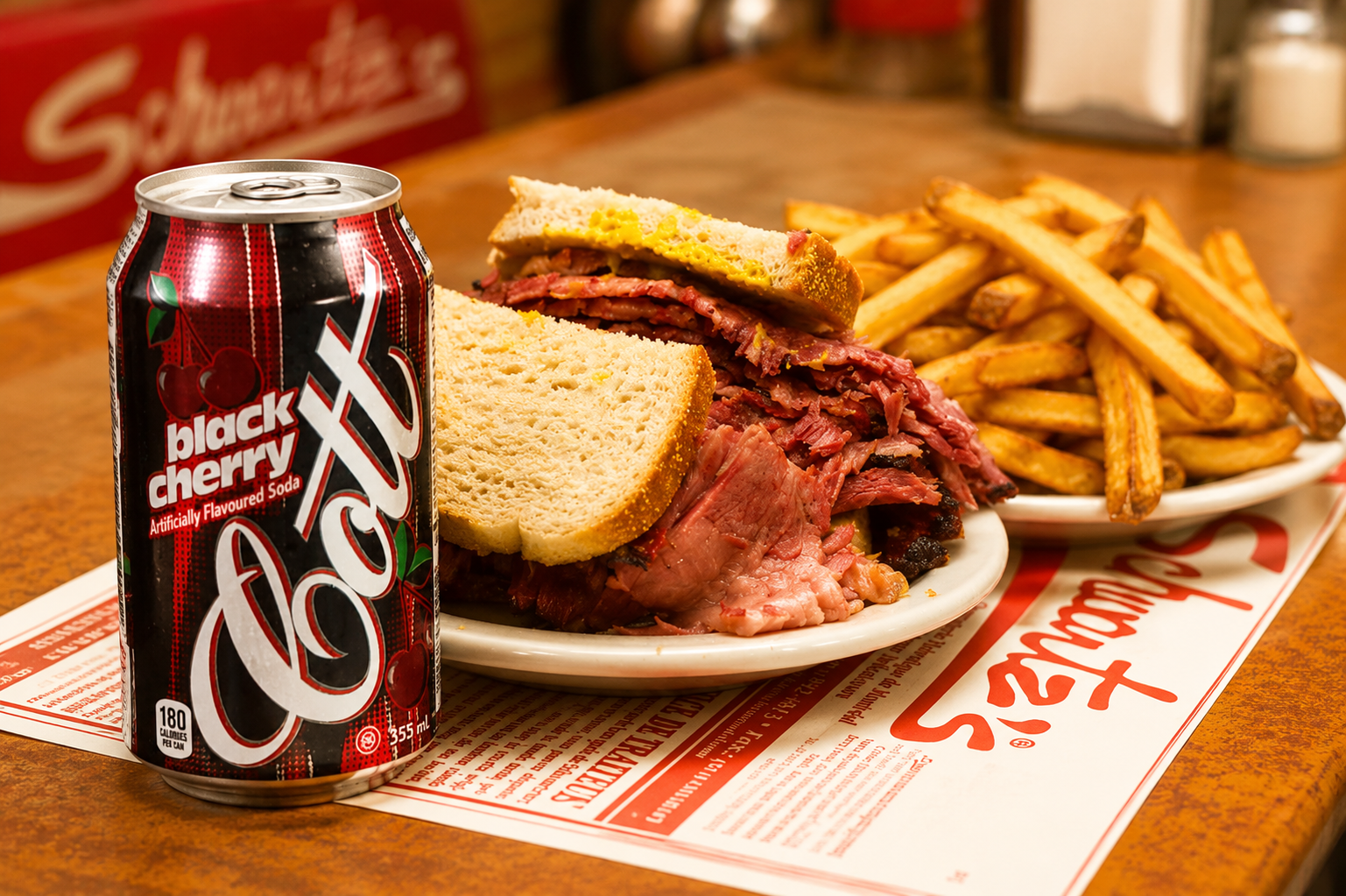
There is a reason people care about this particular beverage. Cott’s Black Cherry has been connected to Schwartz’s and Montreal smoked meat for decades, and the pairing became so familiar that ordering the sandwich with the soda almost seemed like one item. Earlier reporting on the Schwartz’s Cott’s shortage described the classic combination and explained why the carbonation worked so well with the richness of the meat.
That is exactly how I remember it. After all the years I have eaten at Schwartz’s, getting a Black Cherry with the sandwich was always a treat. You did not have to think about whether it belonged there. Of course it belonged there. The first bite of smoked meat followed by that cold, fizzy cherry taste was simply part of going to Schwartz’s. Take away something that has been part of that ritual for years and people are going to notice, even if they cannot quite explain why.
Fleischer’s Isn’t Exactly the New Kid
Here is where the story gets a little more interesting for me. Fleischer’s may be the replacement for Cott’s at Schwartz’s, but the Fleischer name is not some newcomer suddenly appearing out of nowhere because Cott’s ran into trouble. It has roots in Quebec’s much older soft-drink tradition, particularly through Barry Fleischer, the longtime spruce-beer maker associated with Paul Patates in Pointe-Saint-Charles. The family name has been connected to Quebec soft drinks for years, even though I could not find a reliable source establishing exactly when Fleischer’s Original Black Cherry itself was introduced.
That connection brought back a memory for me. When I was young, my parents used to buy spruce beer, so the Fleischer name immediately feels a little more familiar than it might to somebody who has never encountered it before. I remember spruce beer as one of those distinctly Quebec things that showed up at home and seemed completely normal at the time. You do not necessarily appreciate those little food and drink traditions when you are a kid. You just drink them. Years later, you realize they were part of the culture you grew up with.
So maybe Fleischer’s is not such a strange replacement after all. Cott’s may have been the Black Cherry that generations of Schwartz’s customers came to expect, but Fleischer’s comes with its own Quebec history. That makes the change feel less like Montreal losing something and more like one local tradition stepping in for another.
And the New Soda Is Getting a Fair Shot
The funny part is that Fleischer’s is not being universally rejected. Recent customers have been surprisingly positive about the replacement, with some saying the local Black Cherry holds up very well against Cott’s and others simply accepting it as the new partner for their smoked meat. That is probably the best possible outcome because nobody wants to sit through a lunch while listening to somebody explain for twenty minutes that the old soda was better.
There will always be people who prefer Cott’s, and I understand that because I am one of those people who remembers the old combination. But food memories have a funny way of making us defend products that we probably never thought much about when they were sitting in front of us. We drank the soda, ate the sandwich and carried on with our day. It was only when the soda disappeared that we realized how much we had attached to it.
Blame the Trade War
The current disappearance of Cott’s is being linked to the ongoing Canada-U.S. tariff fight, bringing an old problem back into the spotlight. Schwartz’s dealt with a similar shortage in 2018, when tariffs and an aluminum shortage were blamed for disrupting the supply of Cott Black Cherry. At the time, however, there was some disagreement over whether the tariffs themselves were responsible or whether the broader aluminum shortage was the bigger issue.
That history makes the current situation almost comical. We are talking about a smoked meat restaurant, a can of soda and a customer sitting down for lunch, yet somehow international trade has become part of the conversation. The customer does not care where the aluminum came from, which border it crossed or which company manufactured the can. The customer wants a smoked meat sandwich, a pickle and that Black Cherry sitting beside it.
Somewhere along the line, a can of soda became an economic story. Only in Montreal could we turn lunch into geopolitics.
Maybe This Is How Traditions Change
There is always a temptation to think that changing one small part of a food tradition destroys the tradition itself. I do not think that is necessarily true. Cott’s was part of the Schwartz’s experience for a very long time, but the smoked meat is still the reason people walk through the door. The sandwich is still piled high, the rye is still there, the mustard is still there and the tables are still cramped enough to make you wonder whether personal space was ever part of the original business plan.
And now there is Fleischer’s. Maybe it will never have the same place in my memory that Cott’s does, but that does not mean it cannot become part of somebody else’s. A kid eating at Schwartz’s today may grow up thinking that Fleischer’s Black Cherry is exactly what you are supposed to drink with a smoked meat sandwich. Twenty years from now, that person could be the one complaining when the restaurant changes the soda again.
That is how food traditions work. We get used to something, stop questioning it and eventually decide it has always been that way.
The Can Is Different. The Treat Remains
For me, the Black Cherry was always one of those small things that made a trip to Schwartz’s better. I have eaten there for many years, and there was always something satisfying about sitting down with that smoked meat sandwich and seeing the cold Black Cherry beside it. It was a simple pleasure, but sometimes those are the ones we remember most. You do not need a complicated explanation for why the combination worked. It just did.
So yes, I will miss the Cott’s. I suspect a lot of Montrealers will. I have not tried the Fleischer’s Black Cherry yet, so I am not going to pretend I can judge it. What I do know is that the Black Cherry tradition at Schwartz’s has not disappeared completely. The can has changed, the conversation has changed and the economics behind it have certainly changed, but the basic ritual remains.
You walk into Schwartz’s, order your smoked meat sandwich, grab your pickle, open a cold Black Cherry and take that first bite. And for a few minutes, everything is exactly where it should be, even if the name on the can has changed.
🥪 About Schwartz’s Deli
Schwartz’s Deli has been one of Montreal’s most recognizable food landmarks since 1928. Founded by Romanian immigrant Reuben Schwartz, the deli remains in its original location on Saint-Laurent Boulevard and continues to prepare its smoked meat using the traditional method: brisket is marinated for 10 days with a secret blend of herbs and spices, smoked overnight, steamed throughout the day and hand-sliced to order. The famously compact restaurant has become an essential part of Montreal’s culinary identity, attracting generations of locals, visitors and celebrities who come for the smoked meat, the atmosphere and a taste of Montreal history.
⭐ Good to Know
Established: 1928
Style: Montreal Jewish deli
Known For: Montreal smoked meat sandwiches
Signature: Hand-sliced smoked meat on rye with yellow mustard
Also Known For: Pickles, fries, coleslaw, poutine and cherry soda
Smoked Meat: Marinated for 10 days, smoked overnight and steamed throughout the day
Takeout: Available
Online Shop: Available
Phone: (514) 842-4813
Hours: Sunday–Thursday 10 AM–11 PM; Friday–Saturday 10 AM–12 AM
⭐ What Diners Are Saying
Schwartz’s continues to generate strong praise for its smoked meat, generous sandwiches, historic atmosphere and unmistakably Montreal experience. Recent diners frequently describe the meat as tender, flavorful and worth waiting for, while longtime visitors appreciate the sense of tradition. At the same time, current reviews show that the experience isn’t universally positive: some diners criticize the cramped seating, long lines, pricing and occasional inconsistencies in food or service. The consensus is clear on one thing: Schwartz’s remains an iconic Montreal experience, but the legend comes with expectations.
🍁 Montreal Food Scene
Neighbourhood: Plateau-Mont-Royal / The Main
Montreal Identity: Iconic Montreal Jewish deli culture
Known For: Montreal smoked meat
Local Character: A nearly century-old institution that remains in its original Saint-Laurent Boulevard location
Food Legacy: Schwartz’s is one of the restaurants most closely associated with Montreal’s international food identity, alongside the city’s other historic smoked meat and deli institutions.
📍 Schwartz’s Deli
3895 Boulevard Saint-Laurent
Montréal, QC H2W 1X9