
Tony Medeiros is a Montreal-based blogger with over 20 years of experience covering pop culture and the culinary scene. Known for his engaging reviews and unique insights, he has built a trusted voice for readers seeking informed and entertaining perspectives on food and entertainment. @sandboxworld @tonymedeiros
Everybody loves the latest trendy restaurant. The minute a new place opens in Montreal, people line up to try it. Social media explodes with photos of neon signs, industrial lighting, fancy cocktails, and perfectly plated dishes that almost look too good to eat. I honestly love seeing the creativity behind these places. Somebody sat there picking every color, every chair, every tile pattern, every little detail, hoping it all comes together into something memorable. It is part restaurant, part dream project.
Opening day must feel like a combination of excitement and absolute terror.
You can almost picture the owners standing there watching people walk through the doors for the first time, hoping the food is good, the service runs smoothly, and customers come back. Today’s restaurants have every modern convenience imaginable. Digital menus, delivery apps, sleek branding, online reservations, influencer marketing, custom playlists, and kitchens built around efficiency. Everything looks polished and carefully planned.
But behind all the excitement is the reality nobody wants to talk about.
Montreal has one of the most competitive restaurant scenes in North America. The city is packed with incredible food from every culture imaginable, and that means survival is brutal. About 17% of new restaurants close within their first year, while nearly 80% disappear within five years. Across Quebec, many restaurants are either barely breaking even or losing money altogether because of rising food costs, labor shortages, rent increases, delivery app fees, and customers watching every dollar they spend.
That pressure never really goes away.
Which is why I have always been fascinated by Montreal’s oldest restaurants. Some of them are more than a century old. They are not flashy. Some have outdated signs, worn booths, faded paint, and interiors that feel frozen in time. Renovations are expensive, especially when the dining room is already packed every day. In many cases, customers would probably complain if anything changed too much anyway.
These places survived because they became part of Montreal itself.
The city’s oldest restaurants are more than businesses. They are living history. They tell the story of Montreal through food, immigration, tradition, family recipes, and generations of loyal customers.
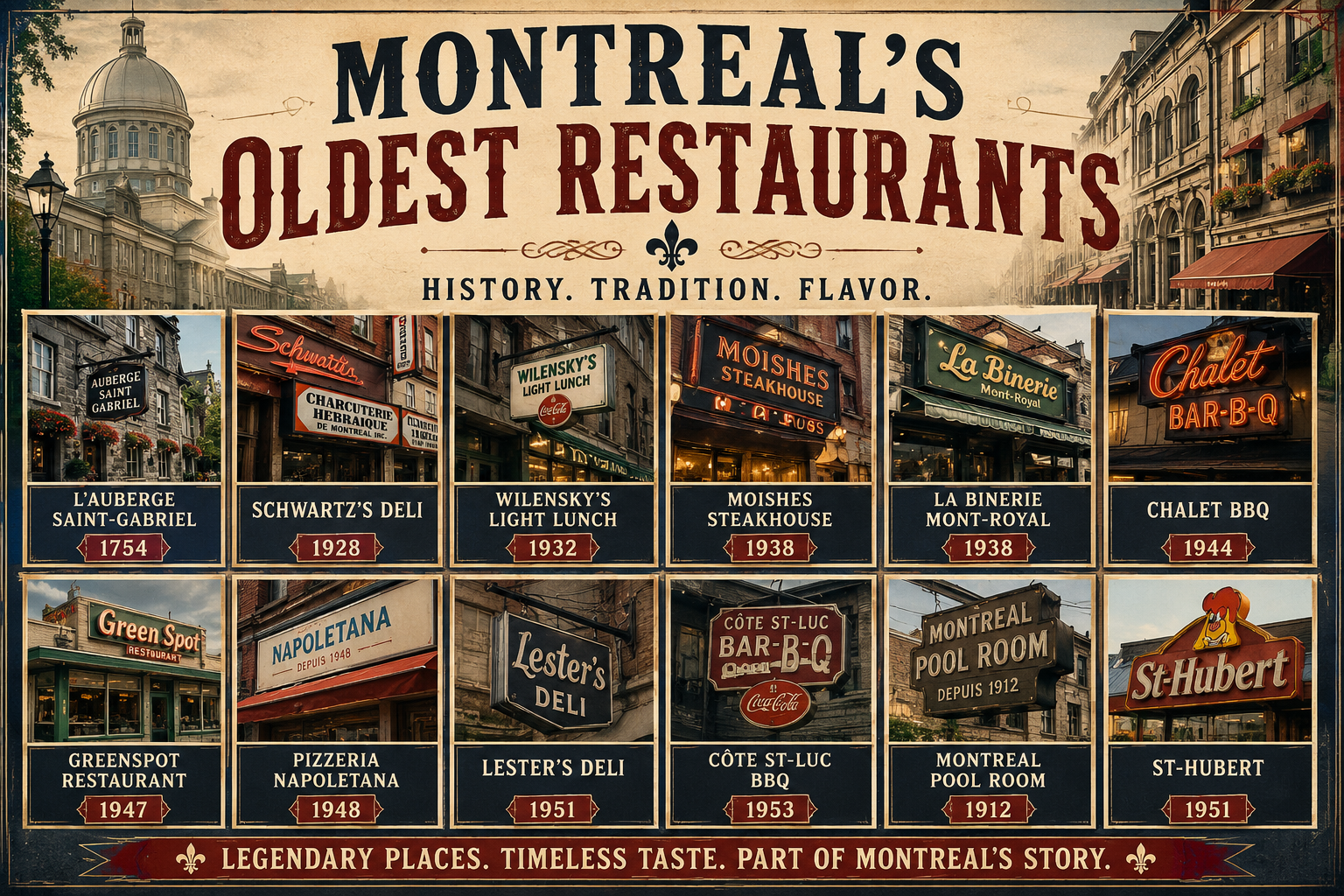
Montreal’s Oldest Restaurants
- L’Auberge Saint-Gabriel (1754)
- Montreal Pool Room (1912)
- Schwartz’s Deli (1928)
- Wilensky’s Light Lunch (1932)
- Moishes Steakhouse (1938)
- La Binerie Mont-Royal (1938)
- Chalet BBQ (1944)
- Greenspot Restaurant (1947)
- Pizzeria Napoletana (1948)
- Lester’s Deli (1951)
- St-Hubert (1951)
- Côte St-Luc BBQ (1953)
One of the most historic is L’Auberge Saint-Gabriel in Old Montreal. Dating back to 1754 as an inn, it is recognized as the oldest functioning restaurant in Canada and was the first inn in North America to receive a liquor license. Walking inside feels like stepping into another century.
Then there is the legendary Schwartz’s Deli, opened in 1928. Tourists and locals still line up for its world-famous smoked meat sandwiches, with thousands served every week. In a city filled with food trends, Schwartz’s never needed reinvention. It simply perfected one thing and stayed true to it.
The same can be said about Wilensky’s Light Lunch in Mile End. Since 1932, it has become famous for one simple sandwich: the Wilensky Special. Salami, bologna, mustard, pressed flat, and famously never cut in half. They do not even serve fries. Only chips. And somehow that refusal to change became part of the charm.
Moishes Steakhouse has been a Montreal institution since 1938. Even after relocating from Saint-Laurent Boulevard to downtown Montreal, it still carries the reputation of old-school steakhouse dining that generations grew up celebrating birthdays and special occasions in.
Traditional Quebec comfort food still survives thanks to places like La Binerie Mont-Royal, serving baked beans, tourtière, and other classics since 1938. This place became part of Quebec culture itself and even earned recognition for preserving traditional cuisine.
In NDG, Chalet BBQ has been serving wood-fired rotisserie chicken since 1944. Meanwhile, Côte St-Luc BBQ turned charcoal chicken and comfort food into a local institution starting in 1953.
Another survivor is Greenspot Restaurant in Saint-Henri. Since 1947, it has remained one of those classic greasy spoon diners where breakfast still feels comforting and familiar, no matter how much the city changes around it.
Montreal’s pizza history would not be complete without Pizzeria Napoletana in Little Italy. Open since 1948, it is considered Montreal’s first pizzeria and helped introduce generations of Montrealers to Italian dining culture.
Then there is Lester’s Deli, another smoked meat icon that has been feeding massive sandwiches to hungry Montrealers since 1951.
And of course, no conversation about old Montreal restaurants is complete without Montreal Pool Room. Since 1912, this legendary steamie spot has survived fires, relocations, and the transformation of the city around it. Somehow, the steamies still taste like old Montreal itself.
One of the smartest survival stories belongs to St-Hubert. While people know it for rotisserie chicken, the chain also helped pioneer food delivery in Quebec decades ago. Snowstorms and hockey nights kept people home, so St-Hubert adapted early and built one of the province’s first major delivery systems.
That may be the real secret behind these restaurants surviving for generations.
Some survived by refusing to change. Others survived because they adapted before everyone else did. But all of them created emotional connections with Montrealers that newer trendy spots still spend years trying to build.
Long after the neon signs fade and the latest food craze disappears, these restaurants are still standing there, serving the same comfort, memories, and traditions that made people fall in love with them in the first place.
Several readers reminded me that I left out some worthy Montreal institutions, and they’re absolutely right.
Honourable mentions go to Beauty’s, Café Cherrier, Dic Ann’s, Dilallo Burger, Elio Pizzeria, Nick’s, Le Roi du Smoked Meat, and Snowdon Deli.
The reality is that any list like this is going to spark debate. That’s part of the fun of talking about Montreal food. Everyone has their favourite spot, their childhood memories, and the restaurant they swear deserves more recognition.
In Snowdon Deli’s case, I know some people will wonder why it wasn’t ranked higher, considering I once supplied them with rye bread. Fair question. But the goal wasn’t to create a definitive ranking of the greatest restaurants of all time. I was simply trying to keep the list to a top ten.
If I expanded it to a top twenty, a few more legendary Montreal eateries would undoubtedly find their way onto the list. That’s the beauty of this city. We’ve been blessed with an incredible food scene for generations, and there are far more than ten restaurants that deserve to be celebrated. (Thanks, Zeke!)