
Tony Medeiros is a Montreal-based blogger with over 20 years of experience covering pop culture and the culinary scene. Known for his engaging reviews and unique insights, he has built a trusted voice for readers seeking informed and entertaining perspectives on food and entertainment. @sandboxworld @tonymedeiros @goodinothers
I have been thinking about Uber Eats lately, and I keep coming back to the same question. If restaurants are working with such tight margins, why are they willing to give away part of every order to a delivery company? You work hard to get the customer, buy the food, pay the staff and prepare the meal, then somebody else gets paid because the customer didn’t want to get in the car. When you look at it that way, it doesn’t seem like the greatest deal in the world.
But I understand why restaurants do it. Getting people to discover your restaurant isn’t easy. You can have a great chef, a great menu and a beautiful room, but you still need people to find you. Uber Eats puts restaurants in front of customers who may never have known they were there. For a small independent restaurant without its own delivery operation, that kind of reach is difficult to ignore.
That is where “necessary evil” starts to make sense. I don’t think restaurant owners want to hand over part of every sale. They want the customer. If customers are already using the platform, do you really want your restaurant to be the one that isn’t there? Sometimes the choice isn’t between a perfect solution and a bad one. It is between two imperfect choices.
Uber naturally sees the relationship differently. The company says Uber Eats generated more than $270 million in additional revenue for Quebec restaurants in 2024, based on research commissioned by Uber and conducted by Public First. Uber also says 70 percent of surveyed Quebec merchants said the platform helped them reach new customers they otherwise could not have reached. Those are Uber’s numbers, so they need to be viewed in that context, but they do help explain why restaurants continue to use the service.
The problem is that more sales don’t automatically mean more profit. A $30 order isn’t $30 in the restaurant owner’s pocket. There is the food, the person preparing it, the packaging, rent, utilities and all the other costs of running a restaurant. Then there are the costs associated with the delivery platform. Every restaurant has a different situation, so the numbers won’t look the same everywhere.
The customer has a calculation to make too. I understand the attraction because there are nights when you simply don’t want to cook, drive or find parking. You open your phone, find something you like and wait for dinner to arrive. There is nothing wrong with paying for that convenience, but convenience and savings are two different things.
Once you add delivery charges, service fees, taxes and a tip, the final number can look very different from what you thought you were spending. Some restaurants can also have different prices on third-party platforms than they do when you order directly. Suddenly the question isn’t just what dinner costs. It becomes, what am I willing to pay so I don’t have to go get it?
Then there is the question I find even more interesting: who owns the customer? If somebody discovers your restaurant through Uber Eats, they may love your food, but the relationship is still taking place through somebody else’s platform. You made the food, built the restaurant and created the brand, but Uber brought that customer to you. The next time that person is hungry, are they thinking about your restaurant or opening the app again?
That matters because restaurants have become brands. They can have catering, private events, prepared foods, retail products and multiple locations. Getting someone to place an order is one thing. Getting that person to remember your restaurant and come back directly is something else.
I remember speaking with a restaurant owner who told me that a local shopping centre had actually courted him to bring his restaurant concept into the mall. That stayed with me because it showed me how valuable a restaurant concept can be. Shopping centres want restaurants because restaurants bring people, while delivery platforms want restaurants because customers want food brought to them. Everybody is looking for that connection between the restaurant and the customer.
Montreal has seen restaurants try to take more control of that connection as well. During the pandemic, Eater Montréal reported on restaurants looking at alternatives to the major delivery platforms and on operators using their own delivery systems. Some wanted more control over the ordering relationship, while others still saw value in the reach provided by third-party services.
The reality is that every restaurant has a different set of numbers. A restaurant with its own drivers has a different situation from a small place with no delivery infrastructure. A restaurant with an empty kitchen in the middle of the afternoon may be happy to accept another order, while a restaurant already packed on a Saturday night may look at the same order differently.
So I don’t see Uber Eats as the villain, and I don’t see it as the saviour either. This is a symbiotic relationship, and I don’t think it is going away. Restaurants need customers, customers want convenience and Uber has built a very efficient way of bringing the two together. The restaurant gets another sales channel, Uber gets paid for providing the platform and delivery network, and the customer gets dinner without leaving the house.
At the end of the day, the restaurant and the customer have to do a little dance to get the best deal. You might look at Uber Eats and think Uber is the winner, but once you start crunching the numbers, things can look very different depending on who you are. What works for one restaurant may not work for another, and what looks expensive to one customer may be perfectly reasonable to somebody who values convenience more than the extra cost.
For me, I am my own Uber. I drive to the restaurant, sit down, eat the food and get to meet the people who actually made it. I get to see the room, talk to the people working there and get a feeling for the place. That is part of the experience for me. I don’t just want the food. I want to know something about the people and the place behind it.
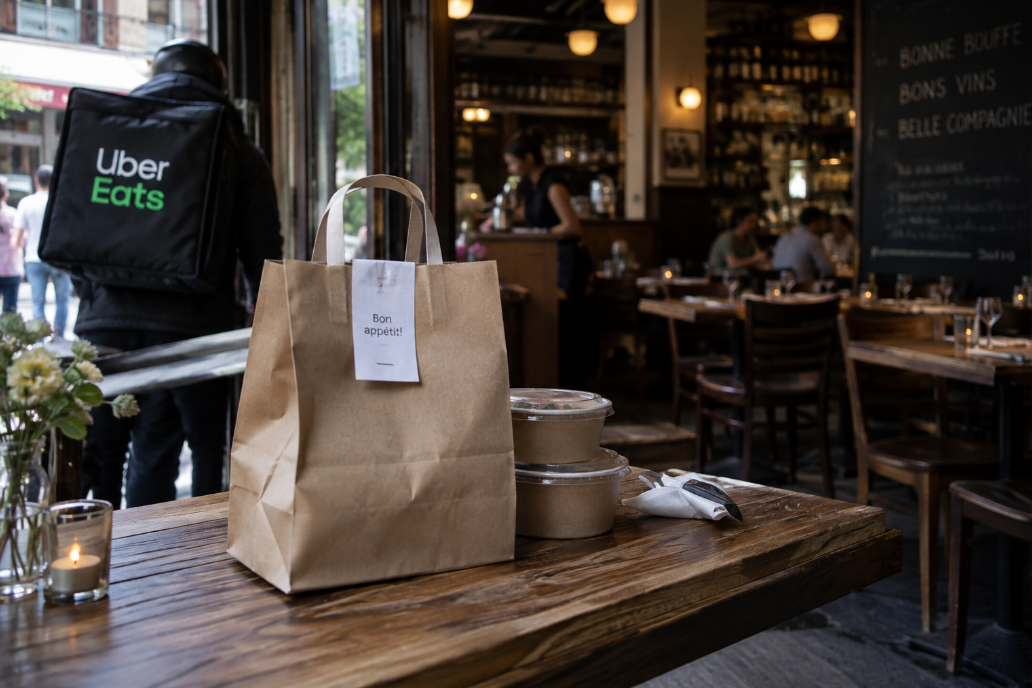
There is also something that happens when the experience is reduced to a delivery. If that Uber driver becomes your go-to guy, he can end up becoming the face of the experience. If the food is late, cold, missing something, or simply isn’t what you expected, the person standing at your door is the driver. He didn’t cook the food, set the price, or pack the bag, but he is the one you see.
Maybe that is what makes this whole thing so interesting. The restaurant wants the customer, the customer wants the convenience and Uber wants to connect the two. It works because everyone gets something out of the relationship, even though everyone is giving something up. We have become accustomed to having almost anything brought to us, and restaurants have adapted because they have to.
But I still like getting in the car and going to the restaurant. I like walking through the door, seeing the room, meeting the people and sitting down with the food in front of me. Maybe I’m old-fashioned, but I think those things are still part of what makes going out to eat different from simply ordering dinner.
There is a price for convenience, but there is also a value in being there.
Your experience should not come in a sealed bag.