
Tony Medeiros is a Montreal-based blogger with over 20 years of experience covering pop culture and the culinary scene. Known for his engaging reviews and unique insights, he has built a trusted voice for readers seeking informed and entertaining perspectives on food and entertainment. @sandboxworld @tonymedeiros @goodinothers
Dunkin’ Donuts was once part of the fabric of Quebec life. A lot of people forget that the very first Canadian location opened in Montreal in 1961 on Sherbrooke Street East. Back then, Dunkin’ was not some trendy lifestyle brand. It was simple. It was familiar. It was the kind of place tied to family outings, weekend treats, and little rewards after school or hockey practice. For me, the magic was always about the donuts first and the coffee second.
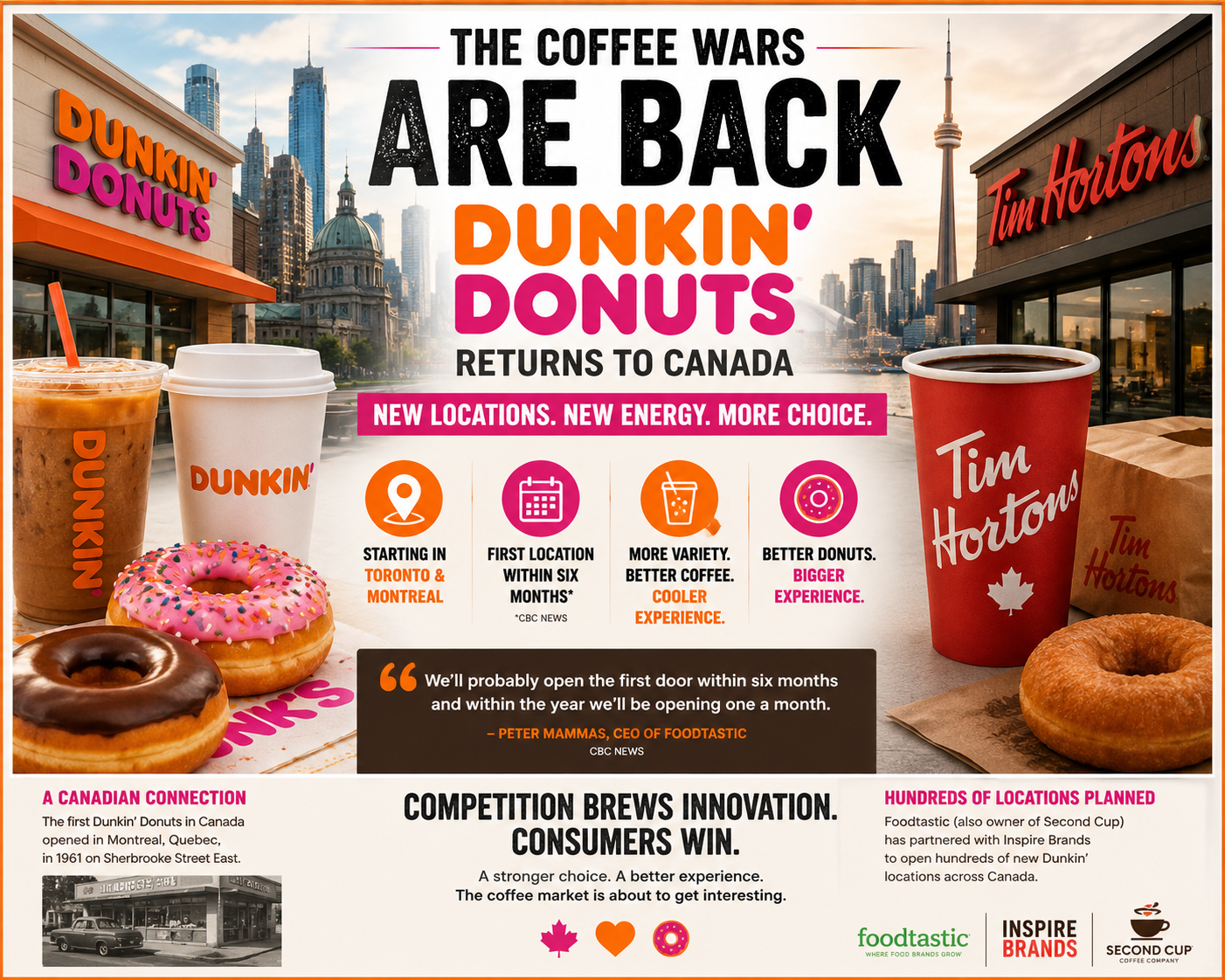
Now, Dunkin’ is preparing for a comeback to Canada through Foodtastic, the company behind brands like Second Cup. They have signed a deal with Inspire Brands to bring back Dunkin’ with hundreds of planned locations beginning in Toronto and Montreal. According to CBC News, Foodtastic CEO Peter Mammas said the first location could open within six months, followed by a steady expansion pace across Ontario and Quebec.
That is a serious statement.
The reality is that Tim Hortons took over the market while Dunkin’ Donuts basically fell asleep behind the wheel years ago. Tim Hortons mastered the art of embedding itself into Canadian culture. Hockey partnerships, Canadiana branding, pop culture tie-ins, small-town familiarity, all of it worked. It became less of a coffee chain and more of a national habit. The elbow-up Canadian pride movement fits perfectly into their image, and honestly, they deserve credit for building that emotional connection.
But success can also create complacency.
Some Tim Hortons locations feel modern and updated, while others look frozen in time because they simply print money without needing to change. The drive-thru near my place constantly backs traffic onto the main road because the demand never stops. The line snakes through the parking lot and clogs everything around it. From a business perspective, you can almost understand the thinking. Why shut down a location for renovations when the cash cow never stops producing?
Inside can sometimes feel even stranger. You walk in and it feels like a permanent study hall mixed with a co-working space. Every table has tutors, laptops, meetings, or somebody who seems to have unofficially rented the corner booth for the day. You start imagining invisible office cubicles around people running entire businesses from individual tables. You know the vibe the second you walk in.
That creates an opening.
The return of Dunkin’ Donuts feels less like nostalgia and more like a strategic disruption. They are clearly targeting younger consumers who want more variety, colder drinks, refreshers, premium coffee options, and better donut experiences. Dunkin’ wants to present itself as the younger, cooler alternative to the traditional Tim Hortons image. Millennials and Gen-Z customers respond to branding, experience, and social media culture differently from previous generations, and Dunkin’ understands that.
Still, this is not going to be easy.
Tim Hortons has more than 4,000 locations across Canada. That kind of dominance does not disappear overnight. Rome was not built in a day, and Dunkin’ knows that. The smart play is exactly what they are doing now: build in major markets first, establish visibility, create buzz, then slowly spread outward.
Consumers win in the end because competition forces everyone to improve.
There is absolutely a hunger for better donuts and fresher experiences. You can already see it with the rise of independent donut shops across Canada offering higher-end products and creative flavors. Krispy Kreme learned a hard lesson years ago when it tried to aggressively take on Tim Hortons head-on. They came in huge, got humbled, scaled back, and eventually found success by carving out a niche instead of trying to dominate everything overnight.
Dunkin’ feels different this time.
Unlike smaller boutique donut shops, Dunkin’ has the marketing muscle, the recognizable brand, and the experience to seriously loosen Tim Hortons’ stranglehold on the market. Tim Hortons became dominant partly because Dunkin’ stopped evolving years ago. Now the tables are turning a little, and some Tim Hortons locations are starting to show that same stagnation themselves.
That is exactly when challengers become dangerous.
I am genuinely excited to see what a revitalized Dunkin’ Donuts looks like in Canada. More choice is always a good thing, and competition usually wakes everybody up. The coffee wars in Canada are about to get a lot more interesting.